

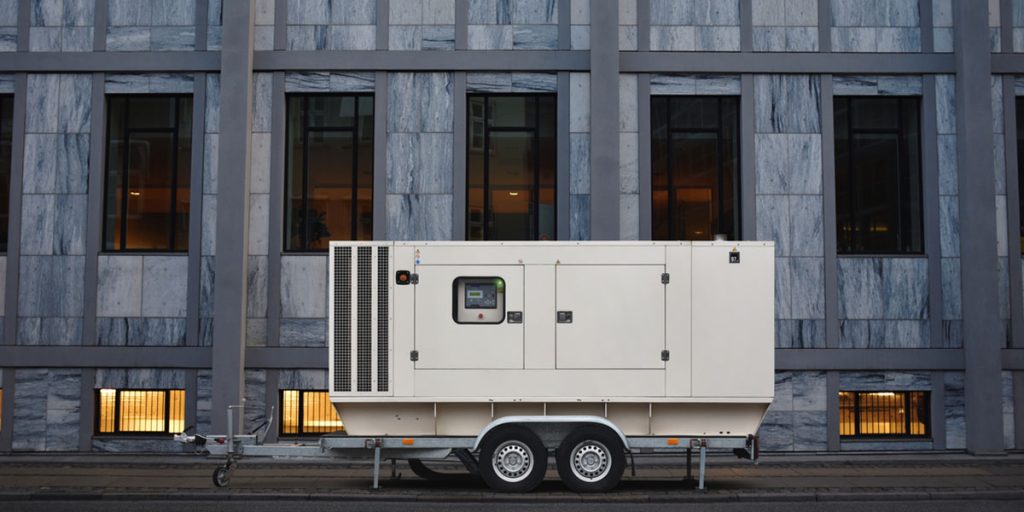
When the lights go out, your business loses time, productivity, and ultimately, money. When major events, like storms or hurricanes, cause outages that last for days, the uncertainty can feel overwhelming.
Unfortunately, power restoration isn’t always quick or predictable. That’s why a solid understanding of the power restoration process is so important. Knowing what to expect, what steps to take during and after an outage, and how to protect your equipment can mean the difference between a temporary inconvenience and a major financial setback.
Restoring power can take anywhere from a few hours to a few weeks, depending on what caused the outage. Understanding how restoration works helps reduce uncertainty and supports better decision-making during a crisis. Power restoration follows a precise process that balances safety and logistics to get operations back up and running as quickly as possible.
Power restoration depends on a combination of conditions, priorities, and resources that shift with every outage.
The scale of the damage is a primary driver of restoration time. For example, a localized issue, like a single downed transformer, can often be resolved relatively quickly. However, when a major hurricane or severe storm damages multiple substations and transmission lines, utility companies face a much larger challenge. In these cases, crews may need to rebuild entire sections of the power grid rather than performing isolated repairs.
Utility companies use a structured restoration hierarchy to bring power back safely and efficiently. The initial and highest priority is restoring power to essential organizations like hospitals, emergency response facilities, and water treatment plants. Next, crews focus on repairing high-voltage transmission lines that supply power to thousands of customers, followed by substations and neighborhood-level distribution lines.
Businesses often fall within these smaller distribution networks, meaning restoration may take longer if critical infrastructure and high-density zones require attention first. This order of operations helps explain why some areas regain power more quickly than others.
Even when crews are ready to work, accessibility issues can slow progress. Blocked access routes can delay the arrival of repair teams. Specialized vehicles and equipment may be necessary to access damaged components safely, and in some cases, technicians must wait for floodwaters to recede.
These logistical realities make storm recovery unpredictable, especially when damage spans multiple cities or counties. Each obstacle adds time to the restoration process.
During large-scale disasters, additional skilled crews and specialized equipment from neighboring states are brought in. While this influx of support accelerates recovery, mobilizing personnel, coordinating logistics, and securing materials all require time and effort.
Storms and hurricanes can cause large-scale power outages. Each weather event triggers a chain reaction, beginning with physical damage and culminating in system-wide safety checks before power can be safely restored.
When sustained winds or sudden gusts hit overhead lines, cables can strike one another or nearby structures, triggering electrical faults and automatic shutdowns.
Flying debris and falling trees amplify the problem. Branches or broken signage can fall directly onto power lines, while uprooted trees may pull down poles entirely. Even when damage looks localized, technicians must inspect and replace each affected component.
Water presents a unique challenge to power infrastructure. Flooding from heavy rainfall or storm surge can submerge underground transformers, substations, and junction boxes. Due to the water’s inherent electrical conductivity, technicians must wait until an area is completely dry before reactivating equipment.
Lightning can cause immediate and severe damage to electrical systems. A direct strike may send a destructive surge through the grid. These surges can damage power lines and also sensitive equipment inside businesses.
When the power goes out, the first few hours matter most. A calm, organized response protects your employees, reduces equipment damage, and speeds up recovery once the grid is restored.
Your team’s safety should always be your top priority. As soon as the power goes out, confirm that all employees are safe and accounted for. Assign someone to check important areas, like workshops, offices, and warehouses, to ensure no one is working near heavy equipment, elevators, or high-voltage panels when the power returns.
Your immediate safety and security process can include the following steps:
Once everyone is safe, shift focus to protecting your business infrastructure. Steps to protect your assets can include the following:
Restoration doesn’t always mean it’s safe to flip every switch immediately. Taking a gradual, careful approach can reduce stress on both your internal systems and the power grid itself.
After power is restored, you may follow these steps:
For most businesses, unplanned downtime results in direct financial losses, strained client relationships, and long-term operational setbacks. When storms or hurricanes strike, waiting for the power grid to come back online is often not an option.
Understanding the actual cost of downtime enables business owners to make informed, proactive decisions, like investing in contingency planning or arranging for temporary power, to protect both their operations and their reputation.
The most immediate impact of an outage is the halt in production and services. Without electricity, machines stop, computer systems shut down, and customer transactions grind to a halt.
Businesses that rely on refrigeration or climate control face additional risks. Spoiled materials, temperature-sensitive products, and wasted inventory can quickly add up to thousands of dollars in losses.
Not every loss shows up on a balance sheet. When your business can’t fulfill commitments, clients and partners may begin to lose confidence. Repeated disruptions can damage your brand’s reliability and reputation, especially in industries where uptime is nonnegotiable, like health care, logistics, and construction.
Employee morale also suffers during extended outages. Workers who are unable to perform their duties may feel frustrated or anxious about job security. Maintaining transparent communication and demonstrating a proactive continuity plan can go a long way toward preserving trust during uncertain times.
Even when operations pause, expenses don’t stop. Salaries, leases, and insurance premiums continue to accumulate, regardless of whether your equipment is running.
Extended downtime may force companies to pay overtime once power returns, just to make up for lost production. That catch-up period compounds costs, creating a cycle that eats into profits and puts additional strain on your workforce.
Businesses that depend solely on the utility grid face a serious disadvantage during outages. Power restoration may take hours or even days, leaving operations stalled and revenue frozen. Rental power equipment gives you control over how quickly your business can get back up and running.
First, determine how much power your business needs. A clear assessment prevents under-sizing or over-sizing, which wastes fuel and increases rental costs.

Renting a generator offers fast and flexible relief during unexpected power outages. Some of the most notable benefits include the following:
Learn more about business power restoration with these answers to common FAQs:
The answer depends on the damage. For isolated line breaks, repairs might take several hours. Widespread wind damage, affecting multiple transformers or poles, can extend the recovery period to several days.
Preparation begins with a clear response plan. Identify important systems that must remain operational and ensure they can connect to a backup generator if needed. Store fuel, emergency lighting, and safety gear in accessible areas, and train employees on shutdown and restart procedures.
Before power is restored, unplug all sensitive electronics and industrial equipment. When electricity comes back, wait 10-15 minutes before restarting major systems. Using surge protectors and power conditioners adds another layer of protection.
High winds cause power outages by knocking trees, branches or debris into overhead lines and poles. Strong gusts can also make lines sway or collide, triggering automatic shutdowns to prevent electrical fires.
A power flash is a bright blue or green burst of light that occurs when electrical equipment fails or live wires touch the ground during a storm. In a hurricane, strong winds and falling debris can cause these faults, creating visible flashes across the sky.
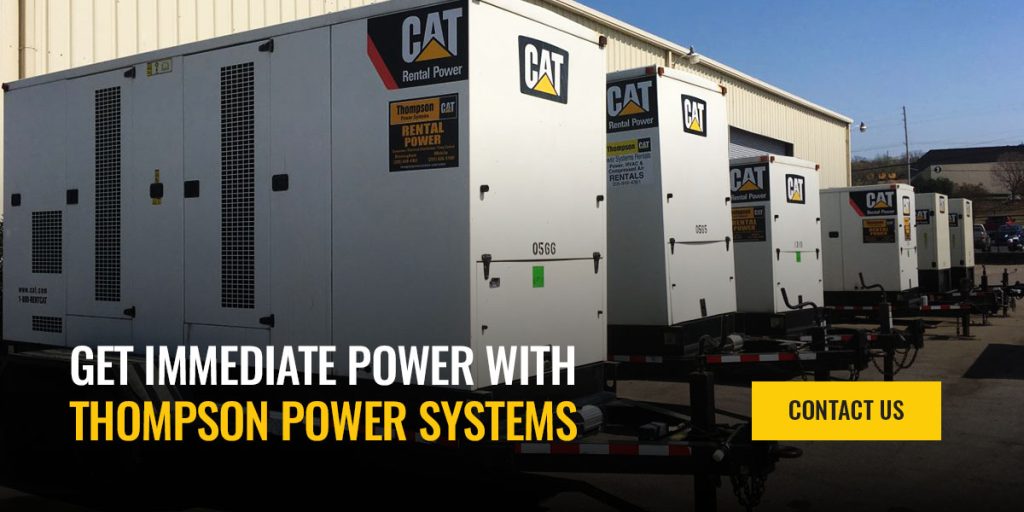
When your business is facing a power outage, waiting isn’t an option. Every hour without electricity means lost revenue, idle employees, and growing frustration.
Thompson Power Systems provides a fast and reliable solution through our extensive fleet of rental generators and temporary power equipment. Whether you operate a construction site, manufacturing plant, distribution center, or office complex, Thompson Power Systems can help you restore power safely and efficiently. Our rental power units are built for demanding conditions and can be deployed quickly after storms or hurricanes.
Contact us today to receive immediate assistance and keep your operations running smoothly.

Get the latest product updates and monthly specials