


Generator sizing is critical to risk management. Undersizing can create a liability where critical life-safety systems fail during an outage, while oversizing can inflate your budget and lead to longer-term maintenance issues.
Knowing what size generator you need for your building planning is rarely answered by a single calculation. It requires balancing the National Electric Code (NEC) requirements with your facility’s everyday operational realities.
Whether you are an electrical engineer performing a load analysis or a building owner approving a final budget, this guide will outline the technical and collaborative processes required to calculate and specify the right power system for your next project.
The importance of accurately sizing a commercial generator cannot be overstated, as it helps you avoid several critical issues:
Prioritizing precision over guesswork protects your facility’s infrastructure, ensures compliance, and safeguards your budget from the risks associated with an improperly sized power system.
Choosing the right commercial building generator requires a comprehensive evaluation of several key factors, extending beyond simple wattage calculations to ensure optimal performance, compliance, and cost-efficiency.
Accurately assessing your facility’s power demands is essential. This includes distinguishing between running watts and starting watts, especially for motors that draw significant inrush current during startup. The nature of your electrical loads is also critical. For instance, nonlinear loads can introduce distortion, necessitating a larger alternator to prevent overheating. Consider your facility’s voltage dip tolerance, as sensitive equipment like medical devices or data centers requires much stricter stability than standard motors.
Plan for future needs by factoring in at least 25% reserve capacity to accommodate potential equipment additions or building expansions, thereby avoiding premature generator replacement.
Environmental conditions at your site, such as altitude and ambient temperature, can also impact a generator’s power output. These factors necessitate derating calculations to ensure the chosen unit consistently delivers the required power in your specific operational environment.
The choice of fuel, primarily diesel or natural gas, significantly influences generator selection. Diesel units are often favored for commercial applications due to their rapid response time and on-site fuel storage, which offer resilience during emergencies.
Natural gas, while providing cleaner emissions and potentially unlimited runtimes via utility lines, is suitable for noncritical standby applications and depends on robust pipeline infrastructure.
Fuel logistics, including regulatory mandates for on-site fuel supply and associated storage design, must be meticulously planned. Operating costs also differ — diesel requires fuel polishing and stabilization, while natural gas carries risks related to pipeline security.
Understanding how the generator integrates with your building’s electrical system is vital. Automatic transfer switches (ATS) are standard safety components that detect grid failures and initiate generator startup without manual intervention. These systems must seamlessly integrate with building automation systems to shed nonessential loads before the generator assumes the full demand.
For enhanced reliability and maintenance flexibility, consider parallel systems that synchronize multiple smaller generators. This modular approach mitigates the risk of a single point of failure, as other units can automatically pick up the critical load if one malfunctions, and simplifies maintenance by allowing individual engines to be serviced without taking the entire facility offline.
To accurately calculate the commercial generator size for your facility, a multi-faceted approach is essential. This ensures that whether you’re performing industrial or emergency generator sizing, the solution is robust, compliant, and cost-effective.
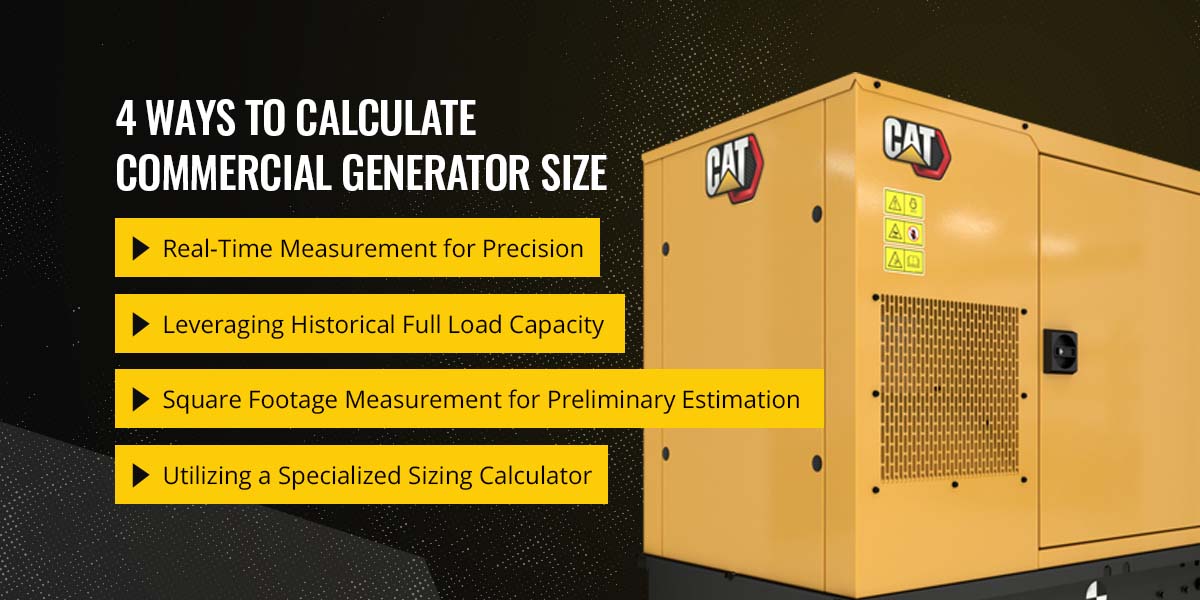
For existing buildings, the most precise method is to deploy specialized monitoring equipment to measure your facility’s actual electrical load in real time. This process captures instantaneous power demands, critical inrush currents from large motors, and load fluctuations over a representative operational period. This data provides a strong foundation for accurately calculating the commercial generator size, reflecting true power consumption patterns.
Another effective technique, particularly valuable for existing infrastructure, is to analyze historical full-load capacity data. By reviewing past utility bills, energy management system records, or BAS logs, you can identify peak demand and recurring energy usage patterns. This historical insight offers a reliable baseline for emergency generator sizing, confirming the maximum power the facility has historically drawn.
While not as granular as real-time data, square-footage measurement serves as a useful preliminary estimation tool, especially for new construction or early-stage planning. This method applies industry-standard power densities tailored to the building’s type and intended use. It’s important to recognize that this approach provides a general guide for industrial generator sizing and requires subsequent refinement through more detailed load calculations.
To consolidate and process the diverse data points, a specialized generator sizing calculator is indispensable. These sophisticated software tools or online platforms allow you to input comprehensive parameters, including total connected load, demand load, various load types, crucial inrush currents, acceptable voltage dip tolerances, and site-specific environmental conditions.
The calculator then applies complex algorithms and derating factors to precisely calculate the commercial generator size, often recommending an optimal range with appropriate reserve capacity. This tool is vital for both industrial and emergency generator sizing, ensuring technical compliance and operational stability.

Proper generator sizing starts with a detailed load analysis, moves through engineering specifications and ends with an owner-approved solution to ensure your project’s safety and continuous operation. Getting it right in the beginning can prevent expensive damages, operational failures and compliance issues down the road.
Ready to verify your calculations? Use our generator sizing calculator to accurately model your building’s unique load power, or contact the expert team at Thompson Power Systems for a personalized review of your industrial generator sizing.

Get the latest product updates and monthly specials