
Components Every Commercial Electrical Control System Should Have
Commercial control systems are essential across the construction and engineering industries, and the general types of commercial control systems can operate a machine or a whole factory process. Understanding the components that every commercial electrical control system should have and control panel selection will help you choose the right equipment for your business and maximize your investment.
Understanding the components of an electrical control system is crucial to optimized operations, cost-efficiency, and safety. The operator should know how the system works as a whole and how every component works individually.
Keep reading to better understand how a commercial electrical control system works, the components of the control system, and how they interact with each other.
Types of Control Systems
The general types of commercial control systems include the following:
Programmable logic controllers (PLCs): PLCs are discreet, versatile controllers for specific functions on robots, production lines, or conveyors. They can handle sequential, repetitive operations.
Programmable automation controllers (PACs): PACs combine PLC features and PC-like processing capabilities to facilitate complex automation.
Distributed control systems (DCS): A DCS features several controllers spread across a network. This enables it to manage large continuous processes, such as power generation, in real time.
Supervisory control and data acquisition (SCADA): SCADA systems control and monitor geographically dispersed assets, such as water systems or pipelines.
Heating, ventilation, and air conditioning (HVAC): HVAC systems regulate a building’s climate with heat, air conditioning, and ventilation control.
Types of HVAC Control Systems
There are various types of HVAC control systems in construction and engineering applications:
Thermostatic controls: Thermostatic control systems sense ambient temperature and switch HVAC equipment on or off to maintain set temperatures.
Pneumatic control systems: A pneumatic control system uses compressed air to operate actuators, which control mechanical components within an HVAC system.
Direct digital control (DDC) systems: DDC systems use microprocessors to control and monitor HVAC equipment with enhanced precision.
Building management systems (BMS) and building automation systems (BAS): BMS and BAS are centralized systems that integrate HVAC system control with other building functions such as security, lighting, and fire alarms.
What Are the Components of an Electrical Control System?
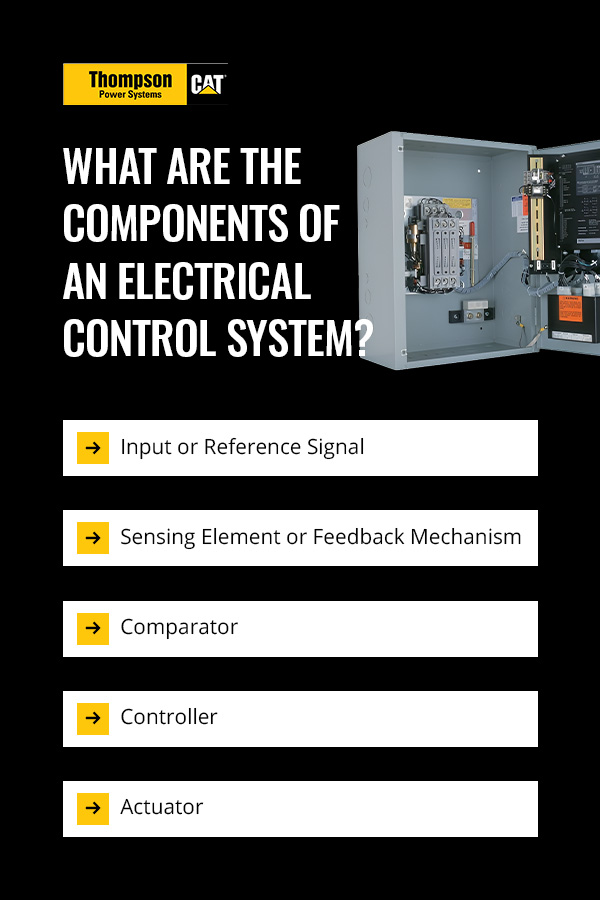
A control system is the entire framework that manages a plant or process. The parts of a control system are interconnected elements that enable a system to sense, process, and act to achieve a desired output. Here are the main components of a control system:
Input or Reference Signal
The input or reference signal is the system’s desired setpoint or value for its output. For example, it may be the temperature you set on a thermostat. The system constantly compares the input to the actual output, making adjustments until they match.
Sensing Element or Feedback Mechanism
A sensing element or feedback mechanism is often referred to as the sensor or transducer. It measures a process’s output, turns it into a signal, and sends the signal back to the comparator and controller for comparison. A sensor or transducer converts a non-electrical impulse, such as pressure, heat, light, or sound, into an electrical signal. This enables the system to perceive environmental changes and starts its feedback loop.
Comparator
A comparator calculates the difference between the actual output and the desired output. It works within the system’s feedback loop, producing an error signal when the actual and desired output values do not align. It then sends an error signal to the system’s controller.
Controller
The comparator and controller are two main control system components that work together. The controller receives the input and the feedback or output signal from the comparator. It calculates the necessary adjustments or corrective actions to minimize the error between the actual values and the desired values. It then uses command signals to make the necessary adjustments so that the input and output values match.
Actuator
The actuator receives a command signal from the controller, converting it into a change or physical action in the system’s manipulated variable. This component directly manipulates or moves a device, such as a valve or damper, and translates the control signal into a physical action. It can manipulate moving parts such as pumps, motors, and valves.
What Is a Control Panel?
A control panel is an automated device or set of devices that controls, distributes, transforms, and regulates electrical energy in an industrial setting. It works as an interface between the operator and the system while ensuring safety. Control panels are usually customized to perform in a specific industry and for a particular application.
What Are High-Tension (HT) and Low-Tension (LT) Electrical Panels?
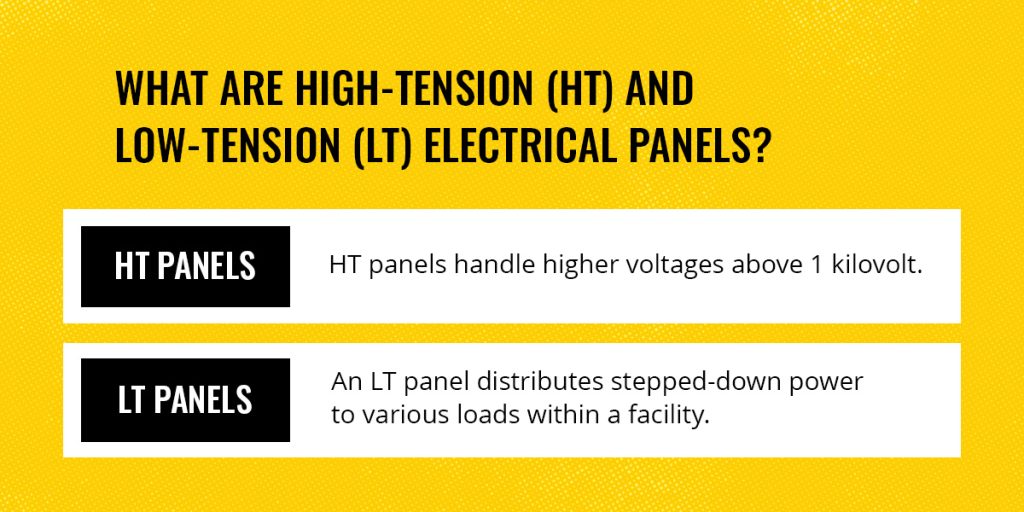
HT and LT panels are electrical distribution panels that manage power at different voltage levels.
HT Panels
HT panels handle higher voltages above 1 kilovolt. They typically support the incoming heavy power or main supply for large facilities and applications.
An HT panel features current transformers (CTs), potential transformers (PTs), vacuum circuit breakers, SF6 breakers, and protection relays to step down incoming power. It requires strict safety clearances, complex installation, and specialized maintenance.
LT Panels
An LT panel distributes stepped-down power to various loads within a facility. It can handle voltage below 1 kilovolt and is the final distribution of power to machinery, motors, and lights within smaller facilities.
LT panels feature components such as air circuit breakers (ACBs) and molded case circuit breakers (MCCBs). They require less complex safety measures, easier installation, and a lower level of maintenance.
What Are the Components of a Control Panel?
Internal and external control panel components communicate and interact to perform a specific task within an industrial process or perform the whole process. The parts of an electrical control system may vary according to the application and customization, including various electrical panel components. Learn more about the electrical panel components in each of the following categories:
Power Management
The following are key power management components:
Power supply: The power supply is essential to any commercial electrical control system. It provides current from the power source, converting alternating current (AC) to direct current (DC) to supply power to all components.
Electric power distribution: The electric power distribution is responsible for converting the incoming electrical power into the current levels and providing consistent power to the different components in an industrial control panel.
Transformers: Transformers are essential to the safety and longevity of your control panel. They adjust the AC voltage to each component’s needs to ensure that every component receives the correct voltage levels.
Surge protection devices: Surge protection devices (SPDs) are essential components for extending the life of your system and ensuring the operator’s safety. When receiving excessive voltage, the SPD will divert it to the ground.
Fuses: Fuses are safety mechanisms that prevent electrical devices from being damaged and lower the risk of electrical fires. They disconnect the circuit when the current exceeds the established limit.
Circuit breaker box: The circuit breaker box is part of a breaker panel that disconnects the circuit before excessive electrical current can damage it. Some parts of a circuit breaker box are the frame, operating mechanism, extinguisher, and trip unit.
Control
Below are important control components for industrial electrical control systems:
Switches: Switches are a type of mechanically operated contactor. They allow the power to be lowered to a normal current, turning off or breaking a component current, and increasing safety, especially for machine control circuits.
Relays: Relays are a type of contactor that allows the control of other electrical components by using an electromagnet to change from a low to a high current depending on the need, making them one of the essential components in a control panel.
Contacts and connectors: Contacts and connectors are similar to contactors (switches and relays). They switch on and off electrical circuits and are designed to control electrical inputs for devices with higher electrical currents.
Protection
Protective features, including the following, are crucial for safe and efficient operation:
Grounding panel: Grounding panels connect different devices in the control panel to the ground as a means of safety, creating a path from the circuit to the ground and reducing the risk of fire hazards or electrical shocks.
Enclosures: Enclosures are aluminum or stainless steel boxes that keep the control panel components protected from weather and other external risks and out of sight.
Fans: Fans, air conditioners, or heat exchangers are cooling systems that help keep the temperature of your system within the limits that allow the control panel to operate smoothly. Cooling systems are crucial to prevent damage to your equipment.
Communication and Monitoring
The human machine interface (HMI) links the operator and the control system. It allows the operator to interact with and monitor the system through user-friendly devices.
Communications enable the different components in your commercial electrical control system to coordinate. They can use ethernet, networking, or PLCs to connect different devices.
Commercial electrical control systems have built-in and automated safety measures. Documentation and training are not physical components of a control panel but are essential to its operation. Having a manual that includes a diagram of the electrical panel parts and providing a proper training program to operators, including the NFPA 70 E Standard for Electrical Safety in the Workplace, will ensure the smooth operation of your commercial electrical control system and prevent accidents.
Motor drives monitor motor operations to ensure an efficient industry process. Their main components are PLCs, manual motor starters, and variable frequency drives.
Other important communication components include:
Programmable logic controller: Programmable logic controllers are the brains of your commercial electrical control system. They are installed inside the control panel for industrial and manufacturing setups and allow the control of electrical and mechanical equipment.
Motor starters: Motor starters are a component of motor drives. They are used to start or stop an electrical motor for commercial applications, providing a stable electrical current that increases safety.
Variable frequency drives: Variable frequency drives (VFDs) are components of motor drives that control the speed and rotation of electrical motors.
Connections
The following are essential connective components for electrical control systems:
Wiring and cables: Wiring and cables are used to put the control panel together. The control panel wiring assembly is inside the enclosure, allowing each part to connect and communicate with each other. Cables are usually thicker than wires and connect the control pane to devices outside the control panel.
Terminal blocks: Terminal blocks manage circuits by connecting multiple or ground electrical wires. They are usually insulated to add safety.
DIN rails: DIN rails are a type of terminal block. They are metal strips that allow wires to be connected and organized in industrial applications, control devices, and equipment enclosures.
How Do I Select a Control Panel?
Use the following criteria for appropriate control panel or control panel component selection:
Application Requirements
The most important consideration when selecting a control panel is what you need the panel to do. Ask the following questions to determine your application requirements:
What specific processes will it control?
How many inputs and outputs do your processes require?
What control algorithms or logic are involved?
Does the control panel need to meet any specific industry regulations or standards?
What level of accuracy and precision is necessary for control?
Do your systems and equipment have any real-time processing requirements?
What safety functions are critical for your processes?
Does your system need to log data?
Physical and Environmental Considerations
Consider the following physical and environmental factors before selecting a control panel:
Location: Will the control panel be indoors or outdoors? Outdoor panels require higher National Electrical Manufacturers Association (NEMA) ratings to protect their components from dust, rain, and ultraviolet (UV) rays. It’s also important to pay attention to safety or explosion-proof ratings if explosive gases or dust are present.
Temperature and humidity: What are your facility’s maximum and minimum operating temperatures and humidity levels? A specialized control panel with climate control accessories is necessary for environments with extreme temperatures or condensation.
Dust and debris: Selecting a control panel with adequate sealing is vital if your facility may expose it to dust, dirt, or airborne particles.
Vibration: Robust mounting is essential for control panels in high-vibration environments. This helps protect the panel from impact and maintain electrical integrity.
Corrosion: Specific enclosure materials, such as fiberglass and stainless steel, prevent damage if your processes may expose the panel to corrosive agents.
Space: What physical dimensions are available for the panel? It’s important to determine if a wall-mounted, floor-standing, or machine-integrated panel fits your space best.
Cabling: Consider how cabling will enter and exit the panel.
User Interface Requirements
Consider how operators will interact with the panel. It’s important to select an option that operators can use easily and efficiently. Look for the following elements if installing a user-friendly panel is a top priority:
Simple buttons, switches, potentiometers, and indicator lights
Text-based displays
Graphic touch screen interfaces with detailed schematics
Visible process variables
Alarms and historical data
The more intuitive an interface is, the less training time operators need. Advanced interfaces also reduce errors, helping you keep operations on schedule.
Communication and Integration
A control panel’s communication with other systems is vital in modern automation. Consider whether you need a panel that communicates with a SCADA system, a DCS, or a BMS. It’s also important to identify what communication protocols you require.
Do your processes require remote control, monitoring, or programming? If so, you must also consider a panel’s security measures for remote access.
Scalability and Future Expansion
Do you plan to add more controlled equipment or input/output functions down the road? If you anticipate future growth and additional needs, opt for a control panel that can easily expand its capacity. A scalable panel provides greater longevity because it can scale with your growth rather than requiring a replacement.
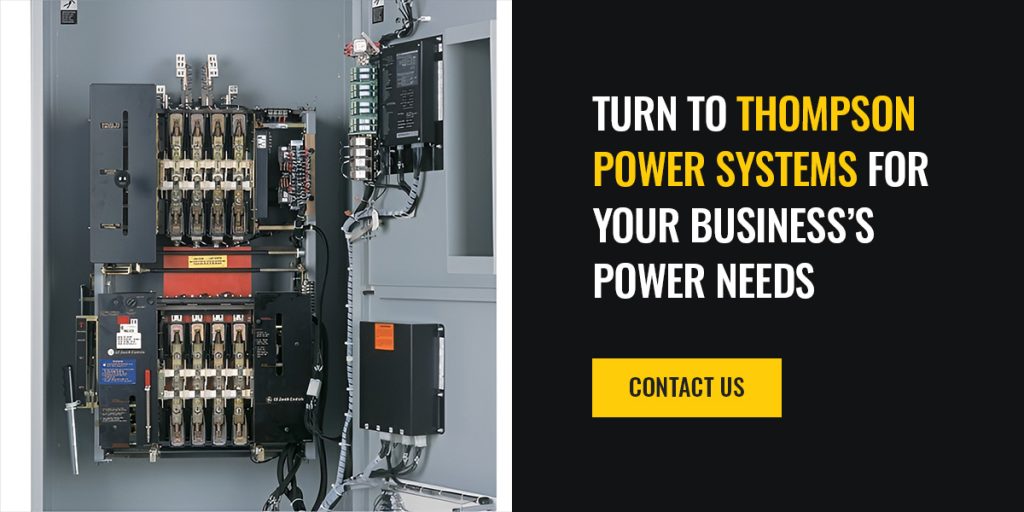
Turn to Thompson Power Systems for Your Business’s Power Needs
At Thompson Power Systems, we understand your business needs. We can assess you and provide rental, new equipment, and used options. We want to see your business succeed, so we have a wide inventory and financial plans so you can keep your investment on budget.
If you are in Alabama or northwest Florida, reach out to one of our executives so we can help you acquire the right power systems or generator sets for your business needs. After your purchase, we provide service to keep your equipment running at all times.